
A handsome photojournalist with a thirst for danger is captured and erotically tortured by a warload in this HOT new series from new author Spum!
Map of the Fallen - Part 1
by Spum
Series: Map of the Fallen
Part 1: Cutting the Parachute
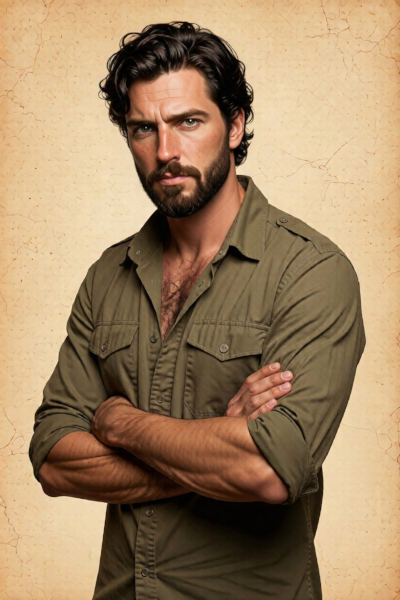 The dust in the valley didn't just settle onto surfaces or the ground. It clung stubbornly to everything, tasting of sulfur and the metallic tang of dried blood, coating the back of the throat with the grit of wars both ancient and recent. Eli thought there must be more ashes of former lives floating in the air around here than almost anywhere else on earth. Where villages and families and hope itself had once been, there was now only a fine powder that found its way into the creases of his skin, the folds of his clothing, his lungs. He had breathed this kind of air before, in other places where civilization had come undone at the seams. He made a conscious, futile effort to never get used to it.
He was merely deceiving himself, though. It bothered him because it excited him, made his heart beat faster, reminded him that he was alive in a way that hotel rooms and dinner parties and the soft, safe streets of London, Geneva, and Copenhagen never could.
Eli stepped off the rattling transport truck with a sly smile that didn't quite reach his hazel eyes. They were his most striking feature. Green flecked with gold and ringed with dark lashes, they had stared down warlords and won, and even convinced militia commanders to let him pass when others were turned back or shot. He was thirty-four years old, and he knew he looked younger than his age in certain lights, older in others. The stubble helped, the three-day growth of beard, matching the messy shock of dark hair that fell across his forehead and that he couldn't stop running his hands through, a nervous habit he'd never managed to break.
His body was the legacy of years of Olympic-level rowing in his youth. Broad shoulders strained against the fabric of his shirt. A broad chest tapered to a firm waist. Thighs like coiled steel that could slice through choppy water across long weekends of training. But the discipline had slipped in recent years, softened by late nights in foreign hotel bars, caffeine-fueled weeks where sleep was a luxury and nutrition an afterthought. The muscle remained, but it had gone slightly to seed, a powerful frame now thickened by a layer of hard living that spoke of street food at 3AM and too much whiskey chased with danger. All the better to add more layers between him and whichever bullet had his name on it, he reasoned. He was still mostly lean and athletic, but there was a heft to him now, a solidity that spoke of a man who had traded the purity of sport for the chaos of experience.
His face was roguishly handsome in a way that defied easy categorization. The angles of his jaw and nose hinted at Arabic heritage from a grandmother he barely remembered, a woman whose photograph his mother wore in a pendant and whose name he had never managed to pronounce correctly. The pale skin and tendency to flush red in the cheeks spoke of Irish blood, his father's contribution, along with the high cheekbones and hazel-green eyes. The combination was striking, and he had always used it to his advantage. It had opened doors for him in places where a more obviously foreign, or less attractive, face might have been turned away. He used it when he needed to, this chameleon quality, this ability to pass in multiple worlds without fully belonging to any of them.
He had been born Elias Strand in Dublin, thanks to Thomas, his Irish father, and he had spent his childhood shuttling between two worlds that each treated him as a visitor. Thomas had been a hard-driving wire-service man, a man who had covered the Troubles, Lebanon and Cyprus with the same devil-may-care gusto he brought to the neighborhood pub. He had drunk himself into an early grave when Eli was nineteen. His mother, Amira, a French-Algerian translator Thomas had met while combing through the rubble of Beirut, had raised him on borrowed money and borrowed stories. She had taught him Arabic and French before he could string together two words in either English or Gaelic. She was diagnosed with cancer the same month Eli made the national rowing squad.
What his father had left him was a battered Leica, a habit of walking toward gunfire, and a question the old man had never been sober enough to ask himself: was he truly driven, or was he simply addicted? Eli had spent fifteen years trying to prove it was the first. However, upon losing the tempering influence of his mother, he realized he was aging into the same kind of man.
He carried the Leica M6 like a talisman, the camera strap worn smooth by years of use, the body dented from a fall in Kabul and a near-miss in Sarajevo. The camera was an extension of his hands and eyes. Through its viewfinder, he became the observer he sought to be: neutral, objective, insightful. The camera created distance. It allowed him to stand at the edge of atrocities and disguise his goal as documentation rather than voyeurism.
By twenty-eight he had a byline in three languages and a reputation for turning up where few dared. He had learned to travel light and lie fluently, to drink raki with militiamen and whisky with colonels, to bribe a fixer with cigarettes and a satellite-phone call home. He was a man who chased discord because the silence of his own life was deafening. Who told himself he was seeking truth, documenting history, when really he was seeking the edge, the place where life felt immediate and real. He had pushed deep into the fractured heart of the region, weaving through scorched villages and checkpoints where soldiers looked more like bandits than army regulars, their eyes sharp with the arrogance of men who had nobody to answer to. He wanted the "killer" story. The kind involving warlords and blood-soaked soil that won Pulitzers. The pursuit goaded him into a reckless confidence, convincing him that he could get by on street smarts and swagger. He believed, with the narcissism of the professionally detached, that his press badge was an impenetrable suit of armor.
 He was wrong. That illusion shattered when they dragged him into the citadel, the moment the heavy iron doors slammed shut behind him.
The sound was a death knell, resonating through Eli's ribcage and settling in his gut. He hadn't been captured by common thugs, but by the personal guard of General Marek, a man whose reputation for cruelty was matched only by his appetite for the exotic. They had taken his camera first. His fingers had twitched with panic as the M6 was yanked away from him by the rough hands of a soldier who grinned with tobacco-stained teeth. Then they took his passport, his boots, and what remained of his dignity, piece by piece, until Eli stood barefoot on cold stone, stripped to his shirt and trousers, forced to his knees in a chamber that smelled of musk and incense.
But some of his swagger remained. A defiant tilt of the chin coupled with a smirk that dared his captors to do their worst. And yet Eli could feel his heart hammering against his ribs. He had been in dangerous situations before, had stared down the barrel of rifles and talked his way through checkpoints manned by twitchy teenagers with Kalashnikovs. But this was different. This was a room built to break men, a sealed vault where even the light and air were fully in his captor's control.
The General didn't react with anger. He didn't shout, didn't strike, didn't offer the crude violence Eli had prepared himself to endure. Instead, he circled the journalist like a predator, his gaze lingering on the muscular frame, the broad shoulders that spoke of rowing laps and gym memberships, the rebellious spark in Eli's eyes that Marek recognized immediately as a mask for something far more vulnerable.
Marek was a man of imposing presence, perhaps fifty years old, with a face that had been handsome before cruelty had etched its lines, dark eyes that missed nothing, and a mouth that seemed perpetually on the verge of a wry smile. He was dressed in a sharp, dark military uniform that seemed to absorb the dim light, polished leather boots clicking against stone with metronomic precision. His hands were adorned with heavy silver rings that caught the occasional shaft of light filtering through high, narrow slits in the walls. With the exception of his wedding band, each piece of jewelry was a gift or a trophy from some chapter of a long war. These rings would soon become intimately familiar to Eli.
A man of cultivated contradictions, Marek wore the uniform of a soldier but had the habits and hobbies of an aesthete. He spoke four languages and read in three. His private rooms held a wall of books and a chessboard with a game perpetually left half-finished. He had been born in a garrison town on the edge of a vanished empire, the son of a schoolteacher and a partisan's widow, and he had spent his whole life watching great powers arrive, make a mess, and leave.
"You are Elias Strand," Marek said finally, and it wasn't a question. His voice was a low, melodic rumble, a sound designed for whispering threats in dark rooms, for making promises that would curdle the blood. "The photojournalist who survived the siege of Aleppo by hiding in a meat locker. Who photographed the execution of the Kabul Twelve from a rooftop three hundred meters away. Who interviewed the Butcher of Banja Luka and walked away with a pot of coffee."
Eli said nothing, his hazel eyes flashing with defiance and calculation. He was already planning: looking for exits, assessing his captor, preparing the narrative he would use to survive. He had talked his way out of worse situations. He would talk his way out of this one.
"You are a parachute journalist," Marek continued, his voice dropping to a lower register, something dangerous coiling beneath the words like a snake preparing to strike. "You drop into the suffering of others, into the blood and the fire, and you document it with your expensive camera and your self-satisfied smirk. You capture the agony of my people, the collapse of our homes, the screams of our children, and you sell it to newspapers in London and New York so that bored commuters can feel a moment of thrill with their morning coffee. You package our pain into entertainment. You turn our deaths into your career."
He stopped directly in front of Eli, close enough that the journalist could smell the cloves and expensive tobacco on his breath, could see the individual flecks of gold in his dark eyes, could count the lines at the corners of his mouth. "You tell yourself you are bringing truth to the world. That you are a witness. That your presence matters, that your photographs shame the world into action. But I know what you really are, Eli. I have seen your kind before. You get high on the danger, on the proximity to death, on the frisson of being almost killed. The near-miss is your drug. The safe danger is your addiction. And then, when the story grows cold, when the bodies are buried and the fires go out, you fly out to the next disaster, leaving us to bury our dead, to rebuild from nothing, or live in the ruins you photographed so artfully."
Eli felt his pulse quicken, not just from fear, but from recognition. There was something in Marek's gaze. It burned with a righteous fury that went beyond the simple hatred of an enemy, a moral contempt that suggested the General believed he was delivering justice rather than merely capturing a prisoner.
"You think you are different from the war tourists?" Marek whispered, his breath hot against Eli's ear as he circled behind him. "The Europeans who pay to watch our battles from hillside perches, taking selfies with the smoke of burning villages behind them? You are worse. Because you pretend to care. You pretend that your presence helps, that your photographs make a difference. But the world does not act, Eli. The world consumes your images and moves on. The dignitaries shake their heads and continue with their dinners. And you? You get your book deal, your awards, your speaking engagements at universities where you tell rapt students about the horrors you witnessed, the dangers you survived, the truth you brought to light. You profit from our pain. You build your career on our corpses."
He reached out, his ring-adorned fingers rising to trace the line of Eli's jaw, and the touch was electric. The cold shock of metal against flushed, overheated skin made Eli jump, a sharp intake of breath escaping his lips before he could stop it. The touch was possessive, a claiming of territory that made Eli's skin heat with a mixture of humiliation and something else, something he didn't want to name.
"I have met men like you before," Marek continued, his voice dropping to a velvet caress that was somehow more terrifying than his anger had been. "Dozens of them. Rugged, charismatic idealists who confuse their trauma response with courage. They come here with their cameras and their arrogance, thinking they are documenting my story, thinking they are untouchable, thinking their foreign passports and press badges will protect them from the consequences of their curiosity. And do you know what I have learned, Eli? What years of interrogating your kind has taught me?"
He stepped back, his gaze roaming over Eli's kneeling form with predatory assessment. "They are all masochists. Every single one. They claim to be observers, neutral eyes, but they are secretly desperate to be made to suffer. They want to be punished for their parasitism. They want to feel, truly feel, the pain they have spent their careers documenting from a safe distance. They want someone to force them to admit that they are not brave. They are simply addicts, chasing their next high in the blood of other people's children. They want to be broken. They want to be owned. They want to finally stop pretending."
Eli tried to pull away, to summon his professional detachment, but the words felt like scalpels, peeling back the layers of a persona he had spent years perfecting. He thought of the rooftop in Kabul, witnessing the execution, the way his heart had pounded. Not with horror, but with something darker, something that felt like excitement. He thought of the car accident in Kenya, the roll of the Land Rover, the strange euphoria that had flooded him in the aftermath. He thought of the checkpoint in Chechnya, the knife at his throat, the way his body had responded with an erection he had been ashamed of for years, that he had never spoken of to anyone, that he had tried to convince himself was just adrenaline, just fear, just biology.
"The Australian who covered the insurgency in the north," Marek continued, circling slowly, boots clicking against stone, his voice taking on the rhythm of storytelling, of ritual. "A giant of a man, built like a rugby player, convinced he was immortal. He wept for three days before he admitted he had been looking for someone like me his entire life. The American from the BBC. Arrogant, witty, muscles honed by CrossFit and capitalist guilt. He lasted a week before he was begging for my touch, offering me secrets he didn't even have in exchange for more pain. The Frenchman… oh, the Frenchman was most entertaining. Such pride. Such philosophy. Such desperate, hungry need beneath it all. His obsession with honing his body through yoga and other exotic exertions. He tried to intellectualize his submission, to frame it as existential exploration. But in the end, he was just like the others. Just like you will be."
He stopped behind Eli, his breath hot against the journalist's ear, his voice dropping to a whisper that seemed to resonate in the very marrow of Eli's bones. "They all ended up on their knees, admitting that they had never felt more alive than when I was hurting them. They all thanked me, in the end. For giving them what they really wanted. For punishing them for their sins. For making them present in their own suffering, rather than gawking at the edge of other people's. For forcing them to admit that they were not journalists, not observers, not brave men bringing truth to the world. They were addicts who had finally found their fix."
He moved around to face Eli, his hand rising to grip the journalist's jaw, forcing him to meet the General's gaze. The touch was firm, possessive, the silver rings cold against Eli's skin. "And now you are here, Eli Strand. Another adrenaline addict. Another submissive who thinks he is special, different, unique. You have spent your life confusing your search for excitement with your need for submission. You chase danger because you want to be caught up in it. You photograph suffering because you want to suffer. You hover at the edge of atrocity because you are too hollow to feel anything genuine, and you hope that proximity to genuine emotion will somehow fill the void inside you."
His thumb traced the line of Eli's lower lip, a gesture that was almost tender in its possession. "The question is not whether you will break. They all break. The question is whether you will be interesting in your breaking. Whether you will have the courage to admit, finally, what you really want. Whether you will be different from the others, or simply another foolhardy rogue who ends up under my boot. Another parachute journalist who finally stopped hovering and simply fell."
PREVIOUS CHAPTER | NEXT CHAPTER